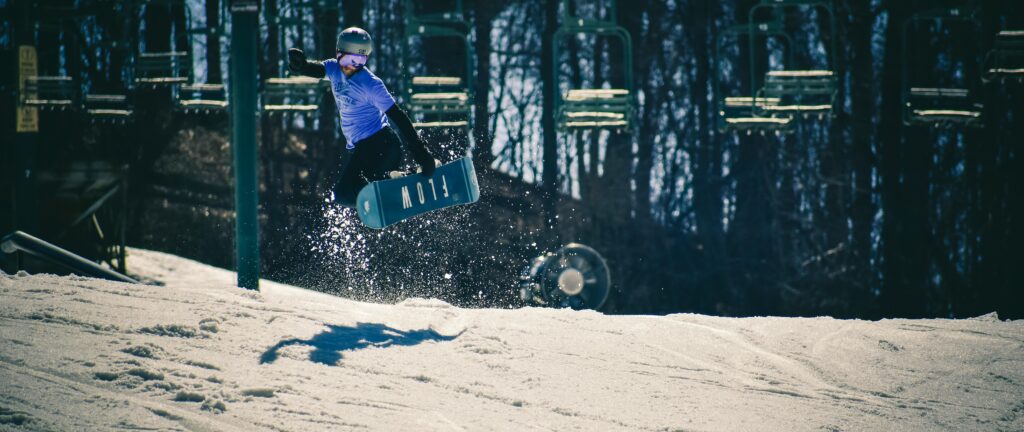
For many American riders, snowboarding means Colorado powder, Utah’s dry snow, or long weekends in Vermont. But crossing the Atlantic for a European snowboard trip? That’s a different kind of adventure altogether.
From massive interconnected ski domains to long alpine lunches and historic mountain villages, snowboarding in Europe feels both familiar and completely new. If you’re an American planning your first European shred trip, here’s what you need to know.
The Scale Is Hard to Comprehend
In the U.S., a “big resort” might mean 2,000–5,000 acres. In Europe, entire mountain regions are linked across valleys and even countries.
Take Les Trois Vallées in France — the largest connected ski area in the world. Or St. Anton am Arlberg in Austria, known for expansive terrain and serious freeride lines. In Switzerland, Zermatt offers riding beneath the iconic Matterhorn, with cross-border access into Italy.
You don’t just ride a mountain in Europe. You explore a network. A single day can involve multiple gondolas, long traverses, and villages you didn’t even know you’d visit that morning.
For Americans used to centralized base areas, this can feel thrilling — and slightly overwhelming.
Trail Markings Are Different
One of the first surprises: European trail ratings aren’t the same as in the U.S.
Instead of green, blue, and black diamonds, many European resorts use:
Blue (easy)
Red (intermediate)
Black (advanced)
A European “red” often feels similar to a U.S. blue or single black, but this varies widely. Terrain can also feel less groomed and more natural in some regions.
Another key difference: off-piste access. In much of Europe, riding outside marked runs is common — but it is not avalanche-controlled the way many U.S. in-bounds areas are. As an American, it’s crucial to understand that “sidecountry” often means true backcountry conditions.
If you plan to explore off-piste terrain, consider hiring a certified mountain guide.
The Food Culture Is on Another Level
One of the biggest cultural shocks (the good kind) is the food.
In many American resorts, lunch might mean a quick burger and fries. In Europe, mountain dining is an event.
Imagine:
Fresh pasta in an Italian rifugio
Raclette and fondue in a Swiss alpine hut
Austrian schnitzel with panoramic mountain views
You’ll find long, leisurely lunches with table service, wine lists, and espresso — right in the middle of your riding day.
In places like Cortina d’Ampezzo, food and style are as much a part of the experience as the snow itself.
As an American used to quick slope-side meals, this slower pace may feel indulgent — and honestly, it’s hard to go back afterward.
Après-Ski Is a Cultural Institution
Après-ski in Europe isn’t just drinks after riding. It’s a full cultural ritual.
In Austria especially, towns like St. Anton am Arlberg are legendary for lively après scenes that start in the afternoon and continue into the evening.
Music spills onto terraces. Ski boots stomp on wooden decks. Strangers become friends over local beer and shared runs from earlier in the day.
Compared to many American resorts — where nightlife often centers around hotel bars — European après feels more communal and spontaneous.
Lift Infrastructure Can Be Surprisingly Advanced
Many European resorts have invested heavily in lift systems. High-speed gondolas, heated chairs, and massive cable cars are common.
However, you may also encounter older drag lifts (T-bars) that require some snowboard technique. If you’re new to riding, practicing T-bar balance before your trip can help.
The upside? Lift tickets are often significantly cheaper than major U.S. resorts — especially compared to high-profile destinations in Colorado or Utah.
Village Life vs. Resort Life
American resorts are often purpose-built. European ski towns frequently date back centuries.
Cobblestone streets, church steeples, and wooden chalets create a completely different atmosphere. In Zermatt, cars are largely banned, and electric taxis quietly move through historic streets.
The experience feels less commercial and more cultural. You’re not just visiting a ski resort — you’re stepping into a living alpine community.
Snow Conditions: Powder vs. Variety
If you’re coming from Utah or Colorado, you may notice differences in snow texture.
The American West is famous for dry, light powder. European snow varies more depending on region and altitude. High-altitude areas in France and Switzerland can offer excellent powder days, but conditions may fluctuate more quickly.
Storm cycles and terrain exposure play a major role. The Alps also offer incredible vertical drops — sometimes far longer than typical U.S. runs.
The trade-off: while powder consistency may differ, the dramatic scenery of the Alps is hard to match anywhere in North America.
Cost Considerations
While flights add expense, daily costs can sometimes balance out.
Lift tickets are often cheaper than major U.S. mountains.
On-mountain dining can be more affordable relative to quality.
Lodging varies widely — from luxury chalets to family-run guesthouses.
With careful planning, a European snowboard trip may not be as financially out of reach as it seems.
Language and Accessibility
In major alpine destinations, English is widely spoken. Navigating France, Switzerland, Austria, and Italy as an American rider is generally straightforward.
That said, learning a few local phrases goes a long way in mountain villages.
Transportation between countries is also surprisingly easy thanks to Europe’s rail systems. It’s possible to ride in France one day and Italy the next with minimal logistical stress.
The Emotional Difference
Perhaps the biggest difference isn’t technical — it’s emotional.
Snowboarding in Europe feels immersive. The mountains feel older, the villages feel rooted in history, and the rhythm of the day feels less rushed.
Instead of racing from lift to lift, you may find yourself lingering over lunch, watching alpenglow settle over jagged peaks, or wandering quiet streets after dinner.
As an American, the experience can shift your perception of what a snowboard trip can be.
Final Thoughts
Snowboarding in Europe isn’t necessarily better than riding in the United States — it’s simply different.
It’s bigger in scale, richer in culinary tradition, deeper in cultural atmosphere, and often more relaxed in pace. It requires a bit more planning and awareness, especially regarding off-piste terrain, but the reward is an unforgettable alpine experience.
For an American rider, a European snowboard trip isn’t just about chasing snow.
It’s about discovering a new way to experience the mountains — one run, one village, and one long mountain lunch at a time.